
Robert Bisnoff identifies cultural traits, in an attempt to find contrasts and congruencies between his American upbringing and the norms of the U.A.E. Click here to also see his gallery of trip photos.
robert bisnoff's marhaba
The men in suits next to us carry on about important meetings in London accents. The Korean couple in front of us gaze and point at the inside of the airport. Dubaian security officers – identifiable by their traditional dress – demurely glance at our passports and ask us a few questions in perfect English. Indian patrolmen wave us through the final security checkpoint before our Lebanese tour guide introduces himself, then our Pakistani bus driver. Both smile genuinely and profusely. This is Dubai. Marhaba.
Leaving what must be one of the world’s most advanced airports, our bus driver takes us through what our tour guide calls, “the most expensive kilometer in the world.” blinking lights give the impression that the futuristic world of Star Trek is a near reality, and that you might be in it already.
But it wasn’t always so. The simple fact remains that less than fifty years ago this highway was a dirt road, our tour bus a caravan, and the “most expensive kilometer in the world” a collection of tents and brick houses.
Now these new and old worlds collide before the world’s very eyes. Just exactly how they collide will be examined over the next two weeks by a group of graduate and undergraduate students from Arizona State University. Through the multidisciplinary lens of Architecture, Healthcare, Journalism, and Political Science, our group will seek to understand better the modern workings of a futuristic city. Then, hopefully, we can assess such a fascinating and revealing urban landscape.
Vanguard City, New Lessons, Old Lessons…Important Lessons

I’m looking to answer personal questions concerning my understanding of our metanarrative. What can we learn from Dubai? Why should we learn from Dubai? Are there any promises or warnings concerning how a society should navigate urban development? I’m also seeking to look at the relevance of examining such a rapidly shifting city i.e. culturally, economically, visually, politically.
I would like to do this without the use of primary and secondary sources, but, and I must admit this, shall be supplementing my writing with related readings on the topic of Gulf history in order to spark thought and creativity in my reflection process.
Something’s Off…
Then there is the “sustainability” question. Now, when it comes to sustainability, there are apparently two sets of query: environmentally and economically.
The questions concerning the economical sustainability of Dubai are for all the obvious reasons. Certainly, Dubai didn’t develop alongside other industrialized nations with the traditional, gradual shift from a primarily agrarian society to a primarily service sector economy – or, the agricultural-artisan-service based economy model.
No, Dubai is taking half-century old oil wealth and trying to catch up to nearly three centuries of urbanized progress, and then surpass it. Such a feat requires both time and money. The Sheikh has plenty of both, and this affords him all of the manpower and machinery necessary to do so.
To round it, Sheikh Mohammed also has the determination to go along with it. But the money may in fact “run out,” like its oil supply, and indeed it may already have. As such, the future of Dubai, or, at least the present vision of the future of Dubai, may have come to a startling halt.
Why are they all so happy? One interesting question that must be answered is this: in the end, no matter how you slice it, Dubai is an international city, whose native’s comprise less than one-tenth of the population. Indian, Pakistani, and Pilipino laborers comprise nearly forty percent, and the rest are ex-patriots from abroad. Not only are they still here but they are also still smiling.
Someone must be doing something right, for in fact how are all of these groups so seemingly happy working in Dubai? Overall, I’ve found it to work like this. The Sheikh takes extraordinarily good care of his people in terms of job security and high wages. This keeps them here, and I had heard about this before my trip to Dubai. The laborers are still making more than what they would at home, and no one is asking them to leave. They may be treated poorly, even unfairly by some humanitarian standards, but are still working and being paid for that steady work, and as a result have no problem keeping their little communities in Dubai and making their meager wages happily.
So, the ex-pats. I mean the British American, and Europeans who choose to work in Dubai. Technically, and perhaps for most, “ex-pats” includes the Pakistani, Indian, and Sri Lankan workers as well. But for an American onlooker, who can’t help but notice such social stratification in Dubai, I verily recognize the European workers to be distinct from the greater “ex-pat” community. So, why do these European ex-pats choose to work in Dubai? One British woman explained it, quite simply, as “I just like to travel.” It all made sense. Our meeting with the architectural firm confirmed this idea.
Working overseas for a pay similar to one back home is nothing short of attractive to those who love to travel. As the architect explained, Dubai really sits nestled between Asia, Europe, etc. A bad economy is a bad economy anywhere: why not experience it in an exotic land? So, that is, in a nutshell, how I reason that Dubai does it. In my figurative book on life, such is a decidedly Roman method of success: treat your subjects well, and you’ll have a shot at keeping them relatively peaceful.
City Life, Arab Life
After some days in Dubai, I’ve come to the realization that a few days here is probably all that I can handle. The story of the city’s development is certainly interesting, but I’ll be honest: I’m more interested in watching the old Arab woman make bread by hand than in examining the infrastructure of Dubai’s suburban communities. But that’s just how I like to travel.
I remember hearing about the whale shark in Atlantis’ aquarium. Apparently, PETA or some other environmentalist group protested and asked to release the rare fish, but the Sheikh refused without batting an eye.
That got me thinking. No doubt the Sheikh is more concerned with the spectacle than with the reality. No doubt the aquarium would be just as impressive without the whale shark.
In fact, standing in front of the aquarium’s looming glass windows, I could hardly see it gliding right below the surface. What does that say about the Sheikh’s concern with appearance? Is the chance to be just that more extravagant too great to pass? Apparently, yes.
Furthermore, what does that say about the Sheikh’s priorities? How should onlookers gauge the level of responsibility with which his next project might be built?
To me, this is what Dubai’s vision of itself is. We walk along the hastily but beautifully built Guggenheim exhibit adjacent to a lavish indoor café. A latte costs a fortune, and you know that before you sit.
We walk by a traditionally dressed Arab male, keffiyeh, sandals and all as he smokes a very large cigar. He gazes over at me as I walk by him, ever so casually. Expecting a disapproving glance from him, he instead looks back down at his newspaper with the same emotionless face, aware that it is we who are the outsiders.
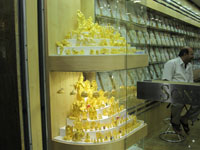
We sit down to join ex-patriots sipping gold flaked encrusted cappuccinos –yes, gold flaked- and begin to converse with a very drunk, very wealthy Norwegian woman on a three day holiday.
The Desert of Dreams
O, the Arabian sun! You can’t help but to compare and contrast sunsets around the world. This color here, that shadow there.
I’ve seen some fantastic sunsets. I maintain that Arizona has some of the most beautiful sunsets on the planet. The low sky, paint brushed colors, and lingering light are otherworldly. But that Arabian sun has got to be up there. It’s a fire red, fast and furious. From what seems like a very ordinary sunset, you get a ball of bright red round in floating off the horizon. Watch closely and quickly because if you blink, it’s gone.
To connect that, I have to admit that what really fascinates me is considering what this sunset has seen. This is the sun of fairy tales, ancient empires, and modern machines. Whatever has happened in this desert, this sun was witness to it. As my classmate says, “the constant” of the world. Wherever Dubai finds itself in years to come, that same sun will have seen it all. I am jealous of the sun.
Lunch Break
Depending on who you are, where you are, and what you’re doing, the term “lunch break” can mean a few variations on the same topic. We had our lunch break in a local restaurant in Sharjha. One of those types of things you might never do again or at least not anytime soon.
Rice and meat. Eaten with your hands. Sure, why not. But it really was lunch time, and that meant that every other class of society was heading for lunch, too.
Across the way from my table I notice a very large Egyptian man sit down and roll up sleeves with a look of hunger and haste across his face. The server brings him a large plate of plain rice, a small container of yogurt, and some meat and vegetables. Eating with his hands, just like we, he empties the yogurt onto the rice and has at it. Hungrily. He licks his fingers and his palms, loving it, like I’d imagine he does every day.
Seemed repulsive, most certainly to the quiet girl situated nearest to him. She got up and left. Then it hit me. He was just a hungry worker like any other hungry worker in any other country.
Lunch time, you’re hungry, and you need some quick, cheap, filling eats. I’ve seen laborers in New York do this too with a can of corn and whatever else they were eating. But wait…I’ve done this too!
Then I thought it out. Watching the Egyptian guy eat lunch, just like any other hungry worker shoveling down lunch -only this time with his hands- is nothing new, just different. Same idea everywhere: we all sit down for that hungry “lunch break.”
Presentation of Islam and UAE culture – Isn’t she British?
I found it interesting to find a fair haired British woman giving a presentation of Islam and the greater UAE culture. She did it wearing traditional abaya and all.
So, I said to a fellow student, “I find it odd enough to find the ex-pats working at the UAE cultural heritage sites, but a local mosque? How peculiar!” The student insisted she was probably doing it out of legitimate concern for the faith and culture, and not just for employment. I doubted her.
The student insisted she in fact probably converted to Islam, remarking “you’d be surprised…” I replied, “…perhaps, but a British woman in Dubai? Surely she is just working here and they were desperate for help.” It turns out I was wrong and she was right. The British woman had “reverted” to Islam and married a local Emirate. Furthermore, she was gleefully using her command of English to present her newfound culture to a wider audience.
That’s when I realized that there is a much richer social and cultural infrastructure in Dubai than meets the eye.
It’s Different
I can’t explain it, but there is a different smell in foreign countries. I can’t explain it, but it exists. It’s the combination, maybe, of slightly different plants and animals, slightly different city scents, different people, different foods. Maybe you just smell the different sights. Whatever it is, you know it’s different. You know that whatever smell that it is, it’s not home. You smell something different, and that’s what counts.
Why? Because that lets you know that there is something different out there.
There are places and people different from what you know. That very tangible recognition must not be ignored.
Harsh Reality

The nurse from al-Ain discussion of birth deformities sparked reflection on the healthcare realities of blending national tradition and Western medicine. The intermarriage presents issues that won’t go away. The government is still conservative enough and respectful enough to ensure that such traditions remain legal.
That is the grim side of Dubai’s dedication to tradition. One could see it as a very real example of the difficulties foundblending Western medical values with Islamic traditions. It was fascinating to find out that you’ll never see the children with defects walking the streets because they keep them inside - their old obsession with appearances.
Eventually, we have to ask, will the world community grow tired of such conflicting values and practices? It doesn’t seem so. Money fuels it all. As long as they have the money, and enough of it to keep running their own affairs at their own speed, then these seemingly ancient ways of life are likely to continue.
Walking Away...For Now
In the end, if there is but one thing to conclude about Dubai, it’s this: Dubai holds a very unique and very important spot in the larger world narrative. Due to a series of miraculous investments both natural and foreign, a family of sheikh’s devoted to a vision of rapid urbanization, and the global fascination with its entire internal and external happenings, Dubai is special. Yes, it is indeed worth examining.
But most importantly, it is worth understanding. The story of a Middle Eastern city striking oil and urbanizing itself at such a breathtaking pace might be something that we see again, and it might not. Dubai was the first to prioritize a futuristic urban landscape in the desert and the first to do it at an unquestionably abnormal pace. Traveling Dubai in the midst of its building boom, with the suspended construction projects and desolated corners of the city, is a once in a life time thing –or, so they’re hoping.
Newscasters will surely be broadcasting about Dubai for years to come. Whether or not those who predict Dubai’s decline in the coming decades are right or wrong is of little import. Only time will tell, and, if the greater world markets have anything to do with it, Dubai won’t be able to tell.
Again, what happened to Dubai this past year demonstrates that no amount of money or determination can shield you from external market forces, or, as I prefer, “reality.” Just another reason we should all be learning from Dubai.
